

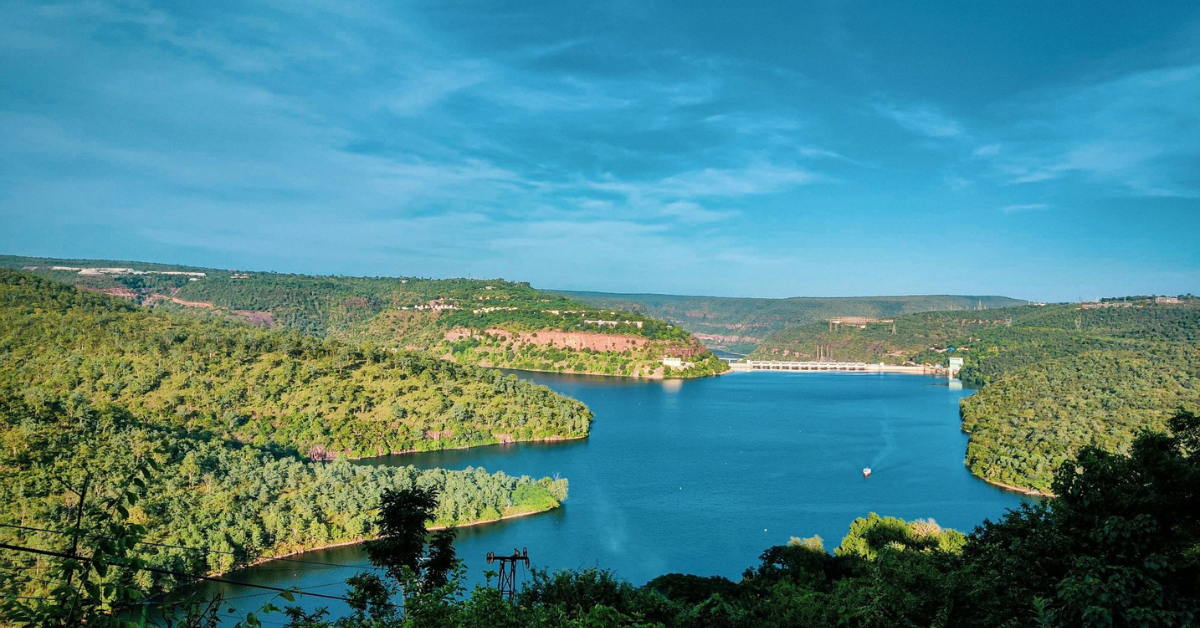
The Krishna River System is one of the significant river basins in Peninsular India, stretching about 1,400 kilometres through the western and southern parts of the country. Its importance lies in its support for agriculture, industry, and millions of people across multiple states. This article aims to study in detail the origin, course, dams, projects and tributaries of the Krishna River.
About Krishna River System
- The Krishna River system is one of the significant river basins within the Peninsular drainage system of India.
- The Krishna River and its numerous tributaries flow through the western and southern parts of the Indian subcontinent, shaping fertile plains and supporting diverse ecosystems along its course.
- With a total length of about 1,400 kilometres, the Krishna is one of the longest rivers in India.
- The Krishna is the second-largest east-flowing river in Peninsular India.
Origin & Course of Krishna River
- Krishna River Origin at Mahabaleshwar near the Jor village in the extreme north of Satara district.
- Ecologically, this is one of the most disastrous rivers in the world, as it causes heavy soil erosion during the monsoon season.
- The Krishna River is bounded by the Balaghat range on the north, by the Eastern Ghats on the south and the east, and by the Western Ghats on the west.
- The total length of the river from its origin to its outfall into the Bay of Bengal is 1,400 km.
- The central part of the basin is covered with agricultural land accounting for 75.86% of the total area.
About Krishna River System
Right Bank Tributaries
The right-bank tributaries of the Krishna River are:
- Venna,
- Koyna,
- Panchganga,
- Dudhganga,
- Ghataprabha,
- Malaprabha and
- Tungabhadra
Koyna River
- The Koyna River rises in Mahabaleshwar, Satara district of Maharashtra and is a tributary of the Krishna River.
- Unlike most other rivers in Maharashtra, which flow east-west, the Koyna River flows north-south.
- The Koyna River is famous for the Koyna Dam, the largest Hydroelectric project in Maharashtra.
- This dam was perhaps the leading cause of the devastating Earthquake (6.4 on the Richter scale) in 1967 that killed 150 people.
- The reservoir – Shivasagar Lake, is a vast lake of 50 km in length.
Panchaganga River
- The Panchganga River flows through the borders of Kolhapur.
- The Panchganga is formed by four streams:
- The Kasari,
- The Kumbhi,
- The Tulsi, and
- The Bhogawati
Ghatprabha River
- The Ghataprabha River originates in the Western Ghats and flows eastward across Karnataka and Maharashtra states before its confluence with the Krishna River at Almatti.
- There is a Gokak Waterfall on the river in Belgaum, Karnataka.
Malaprabha River
- The Malaprabha River originates in Kanakumbi, located in the Belgaum District of Karnataka, at an altitude of 792 meters in the Sahyadris.
- The Navilatirtha Dam, with its reservoir known as Renukasagara, is constructed near Munavalli in Belgaum District.
- The renowned temples of Aihole, Pattadakal, and Badami, which are UNESCO World Heritage Sites, are situated along the banks of this river.
Tungabhadra River
- The Tungabhadra River is formed by the unification of the Tunga and the Bhadra from Gangamula in the Central Sahyadri.
- At Wazirabad, the river receives its final significant tributary, the Musi, upon whose banks the city of Hyderabad is situated.
- Historically, the river was known as Pampa.
- The land wedge between the Tungabhadra and Krishna rivers, situated north of the Tungabhadra River, is called the Raichur Doab.
- Major urban centres along the river include Harihar, Hospet, Hampi, Mantralayam, and Kurnool.
Left Bank Tributaries
The left-bank tributaries of the Krishna River are:
- Bhima,
- Dindi,
- Peddavagu,
- Halia,
- Musi,
- Paleru, and
- Munneru
Bhima River
- The Bhima River originates in Bhimashankar hills near Karjat on the western side of the Western Ghats (Sahyadri) in Maharashtra.
- Bhima flows southeast through Maharashtra, Karnataka and Andhra Pradesh.
- It is the longest tributary of Krishna river.
Musi River
- The Musi River originates in Anantagiri Hills near Vikarabad, Rangareddi district, 90 km west of Hyderabad.
- In 1920, the Osmansagar Reservoir was constructed across the river at Gandipet village.
- Other important dams, i.e. Himayat Sagar and Hussain Sagar Lake, are built on the tributary of the River Musi.
- Together, they act as a source of water for Hyderabad.
- Musi River is also the bowl for water festivals such as boating races, decorated boating contests, and river swimming tournaments.
Cities Located on Krishna River
- Satara,
- Karad,
- Sangli,
- Bagalkot,
- Srisailam,
- Amaravati, and
- Vijayawada is one of the important urban and tourist centres on the bank of the river.